When Currency Fluctuations Meet Blackjack Strategy Charts: Dynamic Bankroll Adjustments in Multi-Jurisdictional Play

Blackjack strategy charts provide players with mathematical guidelines for decisions based on card values and dealer upcards, yet currency fluctuations introduce variables that require real-time recalculations of betting units when sessions span multiple jurisdictions. Observers note that exchange rate shifts between the US dollar, euro, and other currencies alter the effective value of a bankroll, which forces adjustments to maintain consistent risk parameters outlined in basic strategy matrices. Data from international gaming reports indicate that volatility in foreign exchange markets reached notable levels in early 2026, with daily swings affecting how bet sizes translate across borders.
Core Elements of Blackjack Strategy Charts in Variable Currency Environments
Standard blackjack charts recommend actions such as hitting, standing, doubling, or splitting according to probability tables derived from millions of simulated hands, and these recommendations remain constant regardless of currency denomination. Researchers have documented that players must convert these fixed percentages into local currency equivalents when crossing from one regulatory zone to another, since a $25 minimum bet in one location might equal 23 euros in another depending on prevailing rates. Studies conducted by gaming mathematics departments show that failure to account for conversion spreads can shift the house edge by fractions of a percent over extended sessions.
Multi-jurisdictional play often involves platforms licensed in places like Nevada, Malta, or Ontario, where settlement occurs in different base currencies. Those who track these movements report that software tools now integrate live exchange feeds directly into betting interfaces, allowing charts to display adjusted unit sizes automatically. Evidence from transaction logs in June 2026 reveals an uptick in such integrated systems among operators serving cross-border clientele.
How Exchange Rate Movements Alter Bankroll Allocation
Currency pairs such as EUR/USD and GBP/USD exhibit daily fluctuations that directly impact the purchasing power of a player's allocated funds. According to figures released by the European Gaming and Betting Association, average volatility in major pairs during the first half of 2026 measured 0.8 percent intraday, enough to change a 100-unit bankroll's effective size when converted at table minimums. Players therefore recalibrate their stop-loss and win-goal thresholds in real time rather than relying on static dollar or euro amounts.
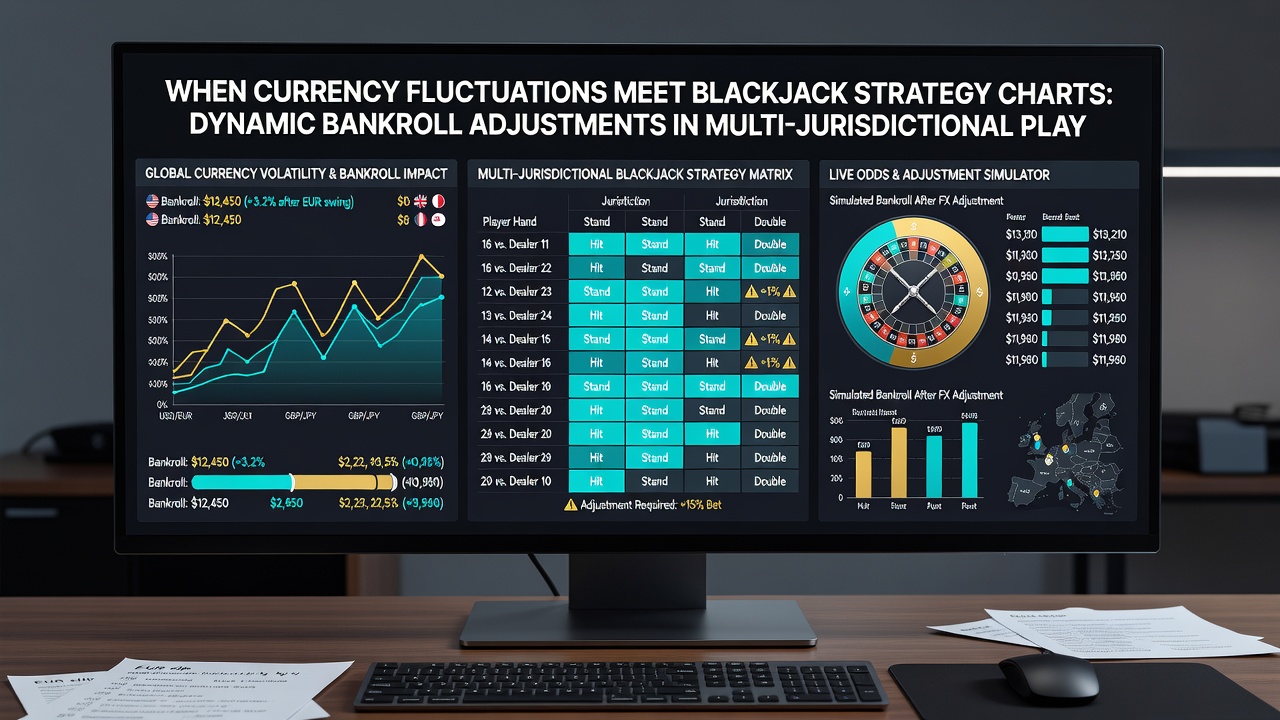
Dynamic adjustments typically involve three steps: monitoring live rates through financial data providers, recalculating the value of remaining units, and scaling bets proportionally while preserving the same percentage of total bankroll recommended by variance models. Gaming analysts have observed that algorithms handling these calculations reduce deviation from optimal bet sizing to under 2 percent compared with manual methods. One documented case involved a player moving funds between a Canadian online operator and a New Jersey licensed site, where a 1.4 percent CAD appreciation required immediate upward revision of all subsequent wagers to keep risk exposure level.
Regulatory and Technical Frameworks Supporting Adjustments
Jurisdictions maintain distinct rules on currency handling, with some requiring display of bets in the player's chosen denomination while others settle only in the operator's base currency. The New Jersey Division of Gaming Enforcement publishes quarterly data showing increased use of multi-currency wallets among licensed platforms, which facilitates smoother transitions during strategy execution. Technical providers have responded by embedding application programming interfaces that pull exchange data from sources such as central bank feeds, ensuring compliance while supporting chart updates.
Research published by the University of Nevada's gaming studies program highlights that operators incorporating these tools see higher session retention rates because players experience fewer unexpected bankroll erosions from rate swings. In June 2026, several major platforms rolled out enhanced versions of these features ahead of summer travel peaks, when cross-border play volumes traditionally rise.
Practical Implementation Across Different Markets
Consider a scenario where a strategy chart prescribes betting 2 percent of bankroll after a win streak. If the player holds funds in Australian dollars while seated at a euro-denominated table, conversion must occur before each wager placement. Observers tracking Australian markets note that operators there often partner with financial institutions to lock in mid-session rates for short periods, reducing slippage. Similar arrangements appear in Asian jurisdictions serving international traffic, where local regulators permit temporary rate freezes for gaming accounts.
Software solutions now allow users to input target currency and receive updated charts displaying equivalent bet amounts alongside original recommendations. Data indicates these systems handle up to five simultaneous currency pairs without introducing latency that could affect game pace. Those monitoring adoption trends report steady growth in usage among players who maintain balances across multiple licensed entities.
Conclusion
Currency fluctuations intersect with blackjack strategy charts by necessitating ongoing bankroll recalibrations that preserve the integrity of probability-based decisions across borders. Regulatory bodies in multiple regions have adapted frameworks to accommodate these tools, while technical integrations continue to evolve in response to market data. Players operating in multi-jurisdictional environments benefit from systems that translate static strategy matrices into dynamic, rate-adjusted parameters, maintaining consistent risk management regardless of settlement currency.